Thursday, December 8, 2016

ARCH 643 Beauty Manifesto

What is Beauty?
How can one define beauty? Webster’s Dictionary defines beauty as the quality or aggregate of qualities in a person or thing that gives pleasure to the senses or pleasurably exalts the mind or spirit. French writer Stendhal refers to beauty as the promise of happiness. Synonyms for beauty include aesthetics, allure, radiance, delicacy, and desirability. But beauty can be defined an infinite number of ways depending on who you ask and what they are referring to. The beauty of watching a sunset - waves washing against your feet, breeze rustling your hair, almost making you chilly enough for a jacket, but knowing you don’t need one because the touch of the wind against your skin is too good to let go of - is different than the beauty of a soldier arriving home from war – deployed for almost a year, the embrace of his mother’s love despite all that he had been through, the loss of numerous friends in battle, an amputated limb to save his life, discharged because of PTSD, yet still a beautiful survivor. Beauty does not have a formula. Beauty looks different to every person.

Beauty gets a bad rap, for people often consider it luxurious at best, superficial at least, and harmful at worst. Ralph Waldo Emerson’s concept of beauty was a quality of association. “The standard of beauty is the entire circuit of natural forms – the totality of nature. Nothing is quite beautiful alone. A single object is only so far beautiful as it suggests this universal grace.” Today we judge things – buildings, objects, people – in isolation. However, the entire makeup of our world is where this association comes from, whether we realize it or not. The idea that the parts should be integral to the whole actually comes from the origin of Western aesthetic theory, Aristotle’s Poetics, in which he demanded that the plot of a good play and the composition of any good work of art must have a distinct beginning, middle, and end: “For if any part can be inserted or omitted without manifest alteration; it is not a true part of the whole.” In other words, the work must be complete in itself – take away any piece, and the whole thing unravels. A flower is beautiful because it reminds us of the colors of the sky; the smell of a forest is beautiful because it reminds us of the scent of our grandmother’s favorite candle; the sound of crunching leaves under our feet is beautiful because it takes us back to our childhood in the woods. Louis Kahn once described his view on beauty.

“When sight came, the first moment of sight was the realization of beauty. I don’t mean beautiful, or very beautiful, or extremely beautiful.  Just simply beauty itself, which is stronger than any adjectives that you might find to add to it. It is total harmony without knowing, without reservation, without criticism, without choice. It is feeling of total harmony as though you were meeting your maker, the maker being that of nature, because nature is the maker of all that is made. You cannot design anything without nature helping you.”

Beauty in Nature
In nature, imagery and ecology are interwoven, and the aesthetic of a living thing emerges from and often echoes its surroundings. The spotted leopard with the dappled shade of the jungle.; fish are bright in the belly – seen from below, they blend with the sky beyond – but they’re dark on top, to disappear in the deep; alone in a field, an oak forms a thick, round canopy, but in dense woods, it stretches straight. Creatures adapt to what’s around them. Life is a shape-shifter. Yet nature expects nothing from us. We can be alone with our thoughts and hopefully find comfort in the presence of beauty around us. Helen Keller felt it wasn’t she but the sighted who are blind, “for they have no idea how fair the flower is to the touch, nor do they appreciate its fragrance, which is the soul of the flower.” How often are we unaware, or perhaps completely blinded, by the beauty that surrounds us every day, even if we have to change our perspective to see it more clearly?

Beauty in Design
“When I am working on a problem, I never think about beauty. I only think about how to solve the problem. But when I have finished, if the solution is not beautiful, I know it is wrong.” Architect Buckminster Fuller understood that aesthetic attraction is not a superficial concern, yet perhaps an environmental imperative. If we only hold on to things that we love or find beautiful, why not apply this thinking to our built environment? Forestry engineer Baba Dioum explains that “in the end, we only conserve what we love.” Perhaps we can replace the old mantra of ‘love it or lose it’ with ‘if it’s not beautiful, it’s not going to last.’ Beauty could save the planet if we start creating things that we find beautiful, because we won’t want to get rid of them so quickly. Psychologist Nicholas Humphrey sees nature not only as an inspiration for design, but as base for all that man creates.

“Go out to nature and learn from experience what natural structures men find beautiful, because it is among such structures that men’s aesthetic sensitivity evolved.  Then return to the drawing board and emulate these structures in the design of your city streets and buildings.”

If design is to act like nature, it should take our breath away. In the view of Finnish architect Juhani Pallasmaa, “the task of architecture is to make visible how the world touches us.” Our built environment can return to a balance that respects the earth for its own sake, rather than viewing it as a resource to be exploited, if we see the beauty it contains.

“Design is not making beauty. Beauty emerges from selection, affinities, integration, love.” –Louis Kahn

Beauty in Life
Apollo 11 was the first manned lunar landing mission with a crew, placing the first humans on the surface of the moon on July 20, 1969 and returning them back to Earth on July 24. However after the Apollo program ended, the writer Norman Cousins told Congress that the most dramatic event of the lunar voyages “was not that men set foot on the Moon, but that they set eye on the Earth.” Up until this point, no human eye had seen the Earth first hand. Photos had been taken of the earth by unmanned space crafts some twenty years before, but the crews of the Apollo missions were the first humans to ever lay eyes on the entire planet. “We came all this way to the Moon, and yet the most significant thing we’re seeing is our own home planet,” said Bill Anders, a member of an Apollo crew. When we begin to realize the magnificence of this planet we have been given, we begin to understand our place in the world and its place inside of us. Sustaining life is not just maintaining a pulse, but rather embracing all the things that make life worth living.

“The truly rampant diseases in our materialistic culture are not of the body, but diseases of the spirit. They arise from lack of self-esteem and mutual respect, being of value to our community, or finding meaning in our lives. These diseases have manifested in rape, substance abuse, addictions, violence, crime, obesity, isolation, depression, and despair – things possible in any culture, but overpowering in ours. They arise from the root violence of our deepest cultural values – our separation from the love of others caused by denying existence of the spirit world. Healing those diseases of the spirit requires that we give primacy to the emotional, energetic, and spiritual well-being of all.”

Beauty in Belonging
A space is successful when a person feels like they belong. Design can create moments of connection with a space. Not everyone feels the same connections through the same elements. A window itself isn’t beautiful, it’s the connection with the world that the window produces that is beautiful. A feeling of belonging can empower a person, making them feel purposeful and alive. It is beautiful to be in a small old house full of people you love rather than in a large decorated house full of strangers. A house of people you love is beautiful because you belong there. Architecture is a matter of relationships. A space itself isn’t what is beautiful. The feeling it creates inside of you is where the beauty lies.

Beauty in Struggle
People are amazing, and never so much as when they are facing an enormous challenge and feeling at their most vulnerable. Maggie Keswick Jencks, a designer, wife, mother, and vivacious lover of life, was diagnosed as having breast cancer in 1988 when she was forty-seven years old. She had a mastectomy, more or less forgot about it and got on with her life.

Five years later, in May of 1993, it returned. She was hurled into a maelstrom. Tests showed that she now had cancer in her bone, bone marrow, and liver. She was told, kindly but baldly, that there was nothing to be done, and that she only had a few months to live. The weakness of her own body seemed to confirm this. She had reached a degree of serenity in which her mind had released its passionate attachment to life and was accepting the ebbing away of her body. Maggie and her family fought her illness with experimental drugs, therapies, even yoga and prayer. She joined an advanced chemotherapy trial and lived for another 18 months. During that time, she and her husband Charles Jencks worked closely with her medical team to develop a new approach to cancer care.

In order to live more positively with cancer, Maggie and Charles believed you needed information that would allow you to be an informed participant in your medical treatment, stress-reducing strategies, psychological support and the opportunity to meet other people in similar circumstances in a relaxed domestic atmosphere. She used her knowledge and experience to create a blueprint for a new type of care. And so Maggie’s Centre was born. Maggie’s Centres provide free practical, emotional and social support to people with cancer and their family and friends. The Centres are places to find practical advice about benefits and eating well; places where qualified experts provide emotional support; places to meet other people; places where you can simply sit quietly with a cup of tea.

Maggie passed away in June of 1995, and the first Maggie’s Centre opened in Edinburgh in 1996. Since then Maggie’s has continued to grow, with 19 Centres at major NHS cancer hospitals in the UK, online and abroad. Maggie’s program of support has been shown to strengthen the physical and emotional wellbeing of people with cancer and their families and friends.

Above all what mattered to Maggie most was to not lose the joy of living in the fear of dying. Struggle and tension is what makes a person know they are alive. The day before she died she sat outside in her garden, on a rare warm June afternoon. Face tilted up to the sun, she smiled and said, “aren’t we lucky?”

Beauty and the Beholder

Beauty is a quality. The world was a beautiful place before we started altering it to fit our needs. A completely untouched canvas that still contained a masterpiece. Nothing is telling us not to continue destroying it for our own benefit. But one day, if we continue on how we are now, it will be gone. Trees will be gone, water will be gone, fresh air will be gone, and therefore we will be gone. We quite literally have the world in our hands, and we have the freedom to do what we want with it. It is humanity’s decision if we will treat it as a treasure or something to exploit. Life is beauty, and we are the beholders.

Wednesday, November 30, 2016

ARCH 643 Beauty

What is Beauty?
How can one define beauty? Webster’s Dictionary defines beauty as the quality or aggregate of qualities in a person or thing that gives pleasure to the senses or pleasurably exalts the mind or spirit. French writer Stendhal refers to beauty as the promise of happiness. Synonyms for beauty include aesthetics, allure, radiance, delicacy, and desirability. But beauty can be defined an infinite number of ways depending on who you ask and what they are referring to. The beauty of watching a sunset - waves washing against your feet, breeze rustling your hair, almost making you chilly enough for a jacket, but knowing you don’t need one because the touch of the wind against your skin is too good to let go of - is different than the beauty of a soldier arriving home from war – deployed for almost a year, the embrace of his mother’s love despite all that he had been through, the loss of numerous friends in battle, an amputated limb to save his life, discharged because of PTSD, yet still a beautiful survivor. Beauty does not have a formula. Beauty looks different to every person.

Beauty gets a bad rap, for people often consider it luxurious at best, superficial at least, and harmful at worst. Ralph Waldo Emerson’s concept of beauty was a quality of association. “The standard of beauty is the entire circuit of natural forms – the totality of nature. Nothing is quite beautiful alone. A single object is only so far beautiful as it suggests this universal grace.” Today we judge things – buildings, objects, people – in isolation. However, the entire makeup of our world is where this association comes from, whether we realize it or not. The idea that the parts should be integral to the whole actually comes from the origin of Western aesthetic theory, Aristotle’s Poetics, in which he demanded that the plot of a good play and the composition of any good work of art must have a distinct beginning, middle, and end: “For if any part can be inserted or omitted without manifest alteration; it is not a true part of the whole.” In other words, the work must be complete in itself – take away any piece, and the whole thing unravels. A flower is beautiful because it reminds us of the colors of the sky; the smell of a forest is beautiful because it reminds us of the scent of our grandmother’s favorite candle; the sound of crunching leaves under our feet is beautiful because it takes us back to our childhood in the woods. Louis Kahn once described his view on beauty.

“When sight came, the first moment of sight was the realization of beauty. I don’t mean beautiful, or very beautiful, or extremely beautiful.  Just simply beauty itself, which is stronger than any adjectives that you might find to add to it. It is total harmony without knowing, without reservation, without criticism, without choice. It is a feeling of total harmony as though you were meeting your maker, the maker being that of nature, because nature is the maker of all that is made.  You cannot design anything without nature helping you.”

Beauty in Nature
In nature, imagery and ecology are interwoven, and the aesthetic of a living thing emerges from and often echoes its surrounds. The spotted leopard with the dappled shade of the jungle.; fish are bright in the belly – seen from below, they blend with the sky beyond – but they’re dark on top, to disappear in the deep; alone in a field, an oak forms a thick, round canopy, but in dense woods, it stretches straight. Creatures adapt to what’s around them. Life is a shape-shifter. Yet nature expects nothing from us. We can be alone with our thoughts and hopefully find comfort in the presence of beauty around us. Helen Keller felt it wasn’t she but the sighted who are blind, “for they have no idea how fair the flower is to the touch, nor do they appreciate its fragrance, which is the soul of the flower.” How often are we unaware, or perhaps completely blinded, by the beauty that surrounds us every day, even if we have to change our perspective to see it more clearly?

Beauty in Design
“When I am working on a problem, I never think about beauty. I only think about how to solve the problem. But when I have finished, if the solution is not beautiful, I know it is wrong.” Architect Buckminster Fuller understood that aesthetic attraction is not a superficial concern, yet perhaps an environmental imperative. If we only hold on to things that we love or find beautiful, why not apply this thinking to our built environment? Forestry engineer Baba Dioum explains that “in the end, we only conserve what we love.” Perhaps we can replace the old mantra of ‘love it or lose it’ with ‘if it’s not beautiful, it’s not going to last.’ Beauty could save the planet if we start creating things that we find beautiful, because we won’t want to get rid of them so quickly. Psychologist Nicholas Humphrey sees nature not only as an inspiration for design, but as base for all that man creates.

“Go out to nature and learn from experience what natural structures men find beautiful, because it is among such structures that men’s aesthetic sensitivity evolved. Then return to the drawing board and emulate these structures in the design of your city streets and buildings.”

If design is to act like nature, it should take our breath away. In the view of Finnish architect Juhani Pallasmaa, “the task of architecture is to make visible how the world touches us.” Our built environment can return to a balance that respects the earth for its own sake, rather than viewing it as a resource to be exploited, if we see the beauty it contains.

Beauty in Living
Apollo 11 was the first manned lunar landing mission with a crew, placing the first humans on the surface of the moon on July 20, 1969 and returning them back to Earth on July 24. However after the Apollo program ended, the writer Norman Cousins told Congress that the most dramatic event of the lunar voyages “was not that men set foot on the Moon, but that they set eye on the Earth.” Up until this point, no human eye had seen the Earth first hand. Photos had been taken of the earth by unmanned space crafts some twenty years before, but the crews of the Apollo missions were the first humans to ever lay eyes on the entire planet. “We came all this way to the Moon, and yet the most significant thing we’re seeing is our own home planet,” said Bill Anders, a member of an Apollo crew. When we begin to realize the magnificence of this planet we have been given, we begin to understand our place in the world and its place inside of us. Sustaining life is not just maintaining a pulse, but rather embracing all the things that make life worth living.

“The truly rampant diseases in our materialistic culture are not of the body, but diseases of the spirit. They arise from lack of self-esteem and mutual respect, being of value to our community, or finding meaning in our lives. These diseases have manifested in rape, substance abuse, addictions, violence, crime, obesity, isolation, depression, and despair – things possible in any culture, but overpowering in ours. They arise from the root violence of our deepest cultural values – our separation from the love of others caused by denying existence of the spirit world. Healing those diseases of the spirit requires that we give primacy to the emotional, energetic, and spiritual well-being of all.”

Beauty in Struggle
People are amazing, and never so much as when they are facing an enormous challenge and feeling at their most vulnerable. Maggie Keswick Jencks, a designer, wife, mother, and vivacious lover of life, was diagnosed as having breast cancer in 1988 when she was forty-seven years old. She had a mastectomy, more or less forgot about it and got on with her life.

Five years later, in May of 1993, it returned. She was hurled into a maelstrom. Tests showed that she now had cancer in her bone, bone marrow, and liver. She was told, kindly but baldly, that there was nothing to be done, and that she only had a few months to live. The weakness of her own body seemed to confirm this. She had reached a degree of serenity in which her mind had released its passionate attachment to life and was accepting the ebbing away of her body. Maggie and her family fought her illness with experimental drugs, therapies, even yoga and prayer. She joined an advanced chemotherapy trial and lived for another 18 months. During that time, she and her husband Charles Jencks worked closely with her medical team to develop a new approach to cancer care.

In order to live more positively with cancer, Maggie and Charles believed you needed information that would allow you to be an informed participant in your medical treatment, stress-reducing strategies, psychological support and the opportunity to meet other people in similar circumstances in a relaxed domestic atmosphere. She used her knowledge and experience to create a blueprint for a new type of care. And so Maggie’s Centre was born. Maggie’s Centres provide free practical, emotional and social support to people with cancer and their family and friends. The Centres are places to find practical advice about benefits and eating well; places where qualified experts provide emotional support; places to meet other people; places where you can simply sit quietly with a cup of tea.

Maggie passed away in June of 1995, and the first Maggie’s Centre opened in Edinburgh in 1996. Since then Maggie’s has continued to grow, with 19 Centres at major NHS cancer hospitals in the UK, online and abroad. Maggie’s program of support has been shown to strengthen the physical and emotional wellbeing of people with cancer and their families and friends.

Above all what mattered to Maggie most was to not lose the joy of living in the fear of dying. The day before she died she sat outside in her garden, on a rare warm June afternoon. Face tilted up to the sun, she smiled and said, “aren’t we lucky?”

Beauty and the Beholder

The world was a beautiful place before we started altering it to fit our needs. A completely untouched canvas that still contained a masterpiece. Nothing is telling us not to continue destroying it for our own benefit. But one day, if we continue on how we are now, it will be gone. Trees will be gone, water will be gone, fresh air will be gone, and therefore we will be gone. We quite literally have the world in our hands, and we have the freedom to do what we want with it. It is humanity’s decision if we will treat it as a treasure or something to exploit. Life is beauty, and we are the beholders.

Sunday, October 16, 2016

ARCH 642 Reflections on Koyaanisqatsi

1. Formulate at least three points of analysis in relationship to your [architectural] interpretation of the film “Koyaanisqatsi” that touch your individual way of understanding spaces. Were you aware of those topics? Explain how.

The movie Koyaanisqatsi started out showing natural features of the world. Which at that point I found interesting because there was no way of knowing when the movie was actually filmed and produced. While our man-made world is constantly changing, the natural world withstands the test of time unchanged. So when people started showing up, and specifically man-made things, it was quite obvious what time period was being filmed, The natural elements were relaxing to watch, while the man-made movement was taxing to watch, yet I still couldn't look away. I think that's a metaphor for how we live nowadays. While we know that giving into the demands of the world can be a bad thing, we can't help but do it anyways.

2. Are those interpretations, those inquiries related to your individual architecture searches? How? Why?

I have always found nature fascinating and necessary, and have always wondered why we don't focus more on incorporating it into the built environment. This movie made it quite apparent that we don't focus on nature, and we haven't been for some time.

 3. Are those interpretations influencing your individual architecture thesis question[s]? How should they be considered in the current architecture discussions? Bring to the discussion examples of that influence.

My thoughts about the movie are strongly reflected in my thesis. My thesis is about incorporating the nature world into the built world, and the movie made it very obvious to me how much that isn't happening and how necessary it is.

4. As a reference search for an article, a piece of architecture, a design position that take into account the topics you are listing/observing.

I recently read an article/journal written by Maggie Jencks, an architect who died in 1995 from breast cancer. She described hospitals as places that people dread going to. While the buildings 'serve their purpose' of providing medical care to patients, they are not conducive to helping people (family, friends or patients) deal with the harsh reality of their illnesses and overcoming them. Maggie came up with the idea of the Maggies Centre, a place for patients and their families to go to deal with their illnesses, get help and comfort, and realize they have a community who supports them, so they know they aren't alone. It's all about designing and providing an appropriate space where these types of interactions and relationships can happen, and people feel comfortable in them.

Monday, October 3, 2016

ARCH 642 Koyaanisqatsi

My word to describe the movie Koyaanisqatsi was MESMERIZING.

dictionary definition of mesmerize:
[mez-muh-rahyz]
1. to hypnotize.
2. to spellbind; fascinate.
3. to compel by fascination.

Others words:
enthrall
fascinate
hypnotize
stupefy

Typically when someone is fascinated by something, you assume it is something good. But this movie I think was the exact opposite. It was a series of videos basically showing the metaphorical bad of what was happening in the world at that time. Yet I still couldn't look away. I don't know if it was because I was amazed by what was happening, or anxious for what would show up on the screen next, but I was mesmerized by it none-the-less. I t brought to my attention the issues of our reality at that time, and made me realize what we had done to 'fix' some of the issues, and what we hadn't done to make some of the issues even worse today. I imagine the other movies related to this one show even more relateable things to my lifetime and experience thus far. Regardless, I was still fascinated with what was happening. Kind of like when you watch Criminal Minds or visit a memorial, it is still interesting to learn more about what has happened, even if it is bad.


Tuesday, September 27, 2016

ARCH 642 Challenge vs. Comfort

Rem Koolhaas explains to us that designers used to come up with really unique and groundbreaking ideas that were unpredictable and maybe even controversial. But now, designers have gotten into this rhythm of predictable and safe designs that don't challenge the designers or the users of the space to have to think about it. We design spaces for specific people and only those specific people tend to congregate there. It used to be that designers could create a space that would apply to multiple types of people and therefore would allow for a variety of humans to come to the space, spurring social interaction with new types of people. Many designers now are afraid to take a chance and try something new and crazy because they fear being ridiculed and rejected.

This is an example of a "comfort" plaza. It is safe, symmetrical, flat, and predictable.


This is a "challenge" plaza. It has a sense of danger, has a giant curve that people can climb on if they desire to, and has multiple levels of space.


While both spaces are intended for people to spend time on and congregate in, they are completely different in design. There is nothing in you that desires to walk to the other side of the safe plaza because you know that it will be the same on one side that it is on the other. But there is a part of you that wants to climb the curve on the challenge plaza, a part of you that wants to run down it or sled or just see what the view is from up higher. The challenge plaza creates different types of spaces for all types of people, not just one massive space for a few types of people.

Wednesday, September 14, 2016

ARCH 642 Invisible Cities


When reading about the city and the sky, I started imagining how you could bring the city level up closer to the sky. I envisioned terraces towering over a city that create a long but meaningful journey up, with connections along the way and multiple paths to choose from. 


One of the city and the sky chapters discussed a city that had a very complex and confusing road system, but if you stood in one specific spot in the city, the paths would all make sense, This model is a conceptual idea representing finding order in chaos. Bright colors, multiple shapes and scales, and blocked views make this environment difficult to travel through, but if you recognize that the patterns on the vertical surfaces are the same as the pattern on the horizontal surface, you can begin to understand the repetition. 

Monday, September 5, 2016

ARCH 642 Theory Less More

LESS seriousness MORE humor
less blah blah blah more ha ha ha

In a society where we are told to be professional, look our best, and behave, it doesn't hurt to break from the norm every once in a while and have a good laugh. Laughter is the best medicine. It is scientifically proven that children laugh significantly more than adults do, but as we grow older we lose our laughter. And that is not okay. If not for pure enjoyment and bliss, laughter can at least help manage stress, decrease blood pressure, and help with anxiety. I think we all get caught up in life and our jobs and forget to have fun with it. I am not immune to it, but I am aware of it. If you aren't surrounding yourself with people who make you laugh or with an environment that you can have fun with, then I think it's time to make a couple of adjustments.


LESS talk MORE action

This is something I have to remind myself of. I am notorious for having big ideas and big dreams for things, but never fully executing them the way I had imagined. That is not to say I am not a highly motivated and goal oriented person, because I am. I think I just am very optimistic when starting something new, and by the end of it the realism sets in and I finally see what I can realistically get done in the amount of time I have and with the resources I have access to. I'm hoping this doesn't happen with my thesis. I have already started doing readings and research for it, so I am trying to get ahead of the game as much as I can while I have the time to do it now. I am very excited about my thesis topic and about the work I have ahead of me to get it accomplished, so I just keep telling myself to 'shut up and do it!'


Tuesday, June 9, 2015

June 9: 22,792 steps in Lima, Peru

Today is our last day in South America. I can’t believe I have been here for the last 25 days. This morning Kristi, Zach, Paige, and I went down to the beach and Zach and Kristi went surfing! Zach already knew how to surf, but it was Kristi’s first time, and she did great! Paige and I sat on the rocky shore and watched as we breathed in the fresh salty air. I ended up getting a little sun burned, but oh well!


This afternoon we went to Lugar de la Memoria la Tolerancia y la Inclusión Social. It is a building built as a memorial and cultural center that just opened. It was a very modern and simplistic building made out of mostly concrete with a very open floor plan.


In the evening Kristi, Ana, Zach, and I went for a coffee and snack before dinner. We ended up liking the place so much that we went back for dinner with the entire group. It was our last super, South America version.


I’m still in awe of everything I have seen and done over the last 25 days. I still can’t believe I did it all. I’m sure I’ll have more words tomorrow as we make our journey home, but for now, I will sleep on it. I found this quote today in the back of our dinner menu, and I thought it was appropriate for our last day in South America. 

Monday, June 8, 2015

June 8: 24,112 steps in Lima, Peru

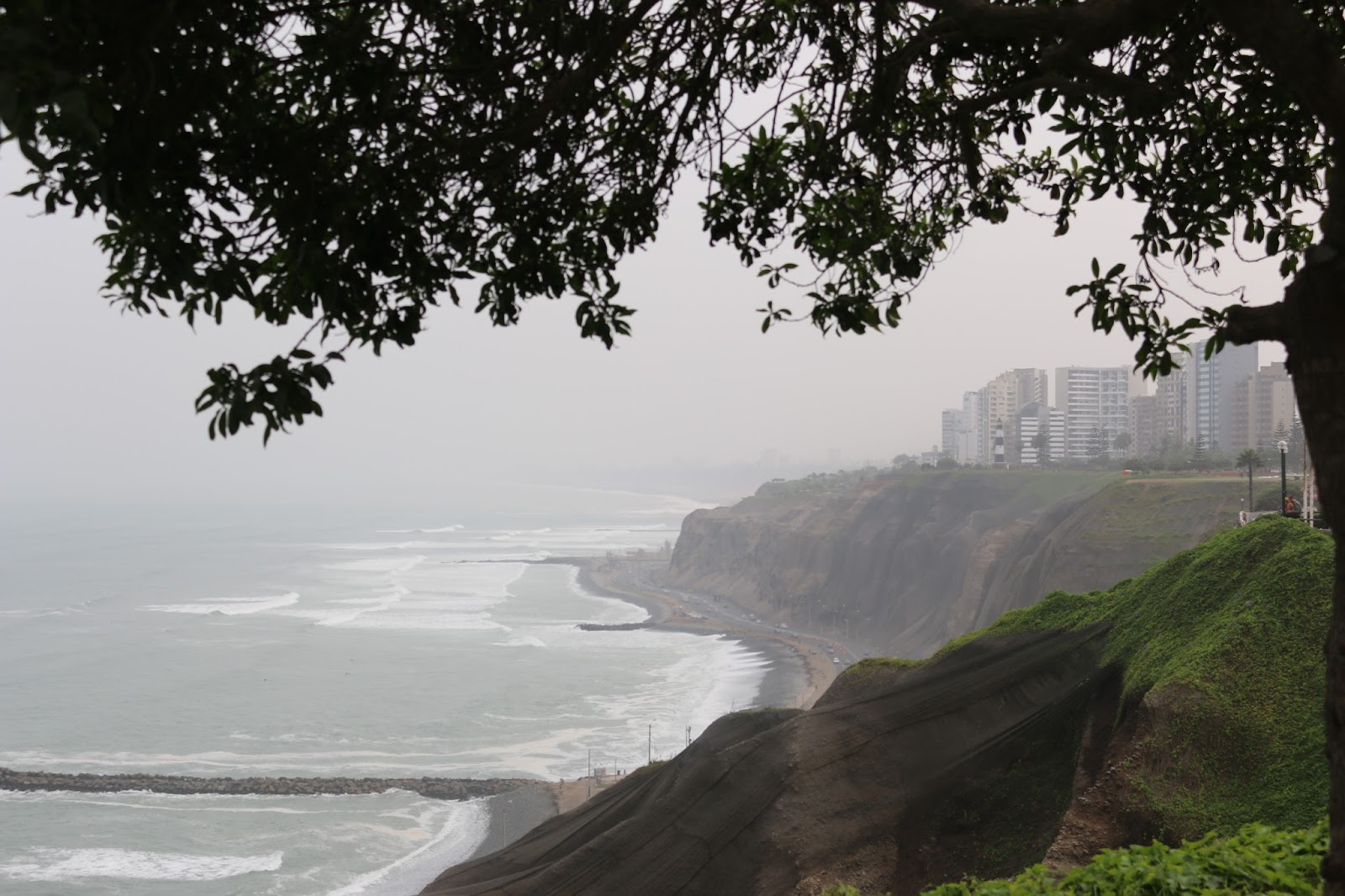
This morning we walked down to the beach. It is very warm and humid here! There is a big drop off from the city down to the beach, so we didn’t actually go down to the water today, but we at least got to see it from above. It was a pretty relaxing morning.


We took a bus to another part of town (Lima is very large) that took about an hour and a half. Traffic is crazy here! I fell asleep on the bus for part of it, so the ride didn’t seem as long to me. We ate lunch, looked at a cathedral, and shopped a little. By then it was 5:00pm, which was rush hour. It took us an hour just to find the right bus to get us back to the part of town we are staying in.  Once we found the bus and got on, it was another long ride back.


We finally got back to the hotel at 7:30pm and rested for a bit before dinner. Dinner was quite the adventure. We went to a pedestrian street that was full of restaurants to find a place to eat. Every couple of steps we took there was a new hostess trying to bribe us to come into their restaurant. Most of them offered us free drinks. We finally decided on a place that offered all of us free drinks, but when we went in he said he couldn’t offer that to us anymore, so we left and went somewhere else. The next place also offered us free drinks, but we ran into the same problem where they could only offer certain drinks for free. Some people in the group were very upset about it, but I just wanted food and didn’t really care. We all had delicious pizza by the end of the ordeal, and I think I finally have my appetite back!


Lima is a lot like New York City. A lot of people, traffic, and things going on. Our experience today is the reality of a large city, and it is important to experience it to understand how some cities work, especially major cities. Grateful for the bus experience, but glad I don’t have to do it again anytime soon!

Sunday, June 7, 2015

June 7: 5,385 steps in the countryside of Peru

This morning we took a train back from Machu Picchu to a town in Peru called Golden Valley. The train left at 8:53am. It was supposed to be an hour long train ride, but about 10 minutes in, we came to a stop. Through the grape vine we learned that the train had come off of the tracks somehow. We sat there for 2 hours waiting for the train to get fixed. I didn’t mind the time to sit and relax and catch up on some photo organization, but many others were unhappy. We were also in a train car with a bunch of high school students who did not know the definition of quiet, so that got annoying real quick. Once the train finally got going again after many stop and start teasers, we made it to our destination at 12:53pm.

We took a bus to a restaurant called Tunpa. It was clearly a tourist restaurant but they had a delicious buffet. I still didn’t have much of an appetite but I managed to get a decent amount of food down, so I was proud of myself. Outside of the restaurant they had parrots just sitting out on perches. They must have been trained because they didn’t seem to want to fly anywhere.


We got back on the bus to go to a local traditional market. The bus ride was beautiful as we drove through the Peruvian countryside. It was how you would imagine traditional South America to be. Small pockets of houses with sheep and goats grazing in the pasture. Locals tending to their fields by hand. The Andes Mountains were always in site. In fact we were still in the Andes, but it didn’t feel like it since I could see the snowy peaks in the distance.


Once we arrived at the market, we got a lesson from a traditionally dressed woman on how they clean and die the alpaca wool and turn it into yarn. She went through all of the steps, including how they make different colors. She showed us how she squished a parasite, which produced a deep maroon color, and then added lemon juice to it to make it bright red.


After the market we continued our bus ride back to Cusco to catch our flight to Lima. Lima is at sea level (thank the Lord) so we can all breath again! It is a very very large city. There are 30 million people who live in Peru, and 10 million of them are in Lima. Our hotel is super nice and we each have our own bed again!

I can’t believe this is our last stop on our South American journey. It’s been long, but fun! I am very excited to be home and see my family and friends again though. Today is my mom’s birthday, so I am 0 for 2 on being home for birthdays this year! Hopefully my souvenirs for them will make up for my absence! 

June 6: 14,325 steps in Machu Picchu, Peru

This morning I woke up not feeling very well again. Mainly I was weak and just didn’t have an appetite. My fingers were also tingly, most likely from lack of oxygen over the past few days. I forced some food down at breakfast and drank some coca tea. Coca is a leaf they have here that helps with altitude sickness. They have it in tea and candy form.

We took a bus to the train station. While at the train station we met a group of students from University of Michigan who were staying in Cusco for 4 weeks doing an art program with weaving. The end of their trip was nearing as well.

The train ride was around 3 hours, but it was beautiful. We rode through the valleys of the Andes all the way, going over parts of streams connecting to the Amazon River and by many peaks, including one called Victoria Peak. I sat next to Ally on the train, and we were facing a couple from Brazil. Luckily they spoke English. They were visiting Machu Picchu as well for the first time. They said they had a 14 year old daughter studying at an American school in Brazil and a 6 year old son studying in a Canadian school in Brazil. They told us about Brazil and how the capital city, which used to be Rio, was moved to a different location about 60 years ago. An architect designed an entire new city called Brasilia located more in the middle of the country which is where the capital now resides. It is not as populated as Rio and is used more for political and business reasons.


We arrived in a town called Aguas Calientes, which is located at the base of Machu Picchu in a valley between the mountains. We dropped off our luggage at the hotel (which was extremely nice!) and headed up. We took a bus that followed a windy road up the mountain to take us to the Incan ruins.

The mountain range once we got up there was amazing! There were so many mountains and peaks I couldn’t believe it was real life. The change in land was very dramatic. The shadows, the points, the greenery…all spectacular.


We got a very good view of the entire ruins from the beginning. I couldn’t believe it was real life. Ana walked around with Kristi and I for most of the afternoon. It was not as crowded there as I expected since it was a Saturday and the weather was perfect. In July and August they actually shut down Machu Picchu to visitors because it is colder and the weather isn’t very good for views.


Machu Picchu had a lot of stairs, and they took the energy out of me real quick. I don’t know how the Incans did it everyday. Ana and I had to stop periodically to take breaks. Usually Kristi is the one with the breathing problems, but she was the one encouraging us to keep going!


The rocks (well actually more like boulders) that created this fortress were put together very tightly and precisely. Each stone had an exact place it could fit in the mold. The Incans obviously built it well because we were allowed to walk all over it. Usually places with ruins are blocked off from tourists to actually walk on and touch. We were allowed to sit on the walls, touch the rocks, and climb the stairs just like the Incans did!


There was a tree growing in the middle of the ruins that really made a statement. I’m not sure if the Incans planted it or if it just naturally started growing there, but it is growing right in the middle of a large open grassy space all by itself. It looked like an African tree, and it was really neat to see it thriving in the middle of this memorial.


Something else that was thriving were llamas! Wild llamas were roaming around the ruins, eating the grass and tormenting the tourists. They weren’t afraid of tourists that’s for sure. The llamas are pretty much permanent lawn mowers up there, and they must like it because they were hopping from one terrace to another like it was just a small step.


There were some pretty severe drop offs towards the edges of the city in the sky. We found an awesome little cliff that stuck out over everything in a nice shaded area. The sun gets pretty hot up there since we are a lot closer to it that normal, so shade was lovely to find. We sat up there and stared out over God’s creation, and took some really cool pictures, of course. There was tiny little pellet poop on this cliff, and we were curious what animal it belonged to, because it definitely wasn’t from a llama.


As we were walking away from our secluded lookout point, Kristi spotted something amazing. All she said to me was “I see an animal, but I’m not going to say what it is because I don’t want to get your hopes up if I’m wrong.” Luckily, she wasn’t wrong. On the side of the drop off she saw 2 chinchillas taking a break from their nocturnal slumber! They were much bigger than my pet chinchilla, Vinny, but they were definitely chinchillas. They had the ears and the squirrel looking tail and the fluffy soft fur. They didn’t move much, and had the puffy sleepy eyes that Vinny always has during the day. I was looking over the edge at them and Ana about had a heart attack, so we had to retreat.


I ran into a girl with an AXO shirt on a few minutes later. She was from Virginia Tech. So cool to find a sorority sister at the most random place!


In Machu Picchu the Incans had a large stone called the Energy Rock. And I was in need of some energy. Legend has it if you touch the rock it gives you energy. So naturally I hugged the rock, trying to transfer as much energy from the rock to my body as I could. I don’t think it worked, but it was worth a shot.


A little while later after walking through the ruins, we saw another chinchilla, this time even closer! He had the same sleepy eyes, but didn’t seem afraid of us. We watched him for a while, and he sat there being sleepy. Then he ran up higher in the rocks, just like Vinny, and as quick as Vinny.


Towards the end of our visit, Kristi and I climbed up onto a secluded terrace overlooking the ruins. Kristi sketched and I sat and rested. It got a bit toasty since we were sitting in the sun, but it was an amazing view. We sat there for about an hour, then headed back down to the entrance for the bus. We also got our passport stamped with a Machu Picchu stamp! Pretty cool!


We took the winding road back down on the bus to Aguas Calientes. We browsed through the market and went to dinner. I did not have an appetite, so I forced down some tomato soup and spaghetti. After a refreshing shower in one of those heavenly rain shower heads, I passed out. 

Friday, June 5, 2015

June 5: 3,243 steps in Cusco, Peru

Before I left the states, someone told me to get an altitude sickness pill from the doctor before going to Machu Picchu. You are supposed to take the pill 24 hours before you go to the high elevation. Machu Picchu is 8,000 feet elevation, which is ironically the lowest elevation we will be at for the past week. I didn’t know going to La Paz that we would be at 12,000 feet, so I didn’t take the altitude sickness pill beforehand. And since I haven’t really been sick since we have been at these high altitudes, I haven’t taken the pill yet. But since we are going to Machu Picchu tomorrow and that was why I got the pill originally, I went ahead and took it this morning, since that was 24 hours before we go to Machu Picchu.

This morning when I woke up, I didn’t feel the greatest. I didn’t feel sick or anything, I just felt weak and had no energy, which is most likely a result of the altitude. So after eating a light breakfast Kristi and I stayed in the hotel room this morning to recuperate. We watched The Planet’s Funniest Animals in Spanish, and then found an English channel. We spent the morning watching TV, playing games on our phones, blogging, and taking cat naps. It was very relaxing.

At 12:30pm we decided we felt good enough to go explore the town some more. We went to one of the markets to look at souvenirs and bought a few things. I don’t know why but it wore me out, so we went to a café where I had water and bread. After that I was still pretty tired, so we went back to the hotel to rest some more. We continued watching the English channel and got to watch Two and a Half Men and Friends! I stayed in for the rest of the night to pack and relax. I eventually found Harry Potter in Spanish, which was fun to watch.


I’m hoping I will feel back to normal tomorrow for Machu Picchu. Luckily we are taking a train there, so we don’t have to hike up any mountains to get to it. And we will be at a lower altitude, so hopefully that and the pill will help!  

June 4: 11,751 steps in Cusco, Peru

This morning we left La Paz, Bolivia and flew into Cusco, Peru. The flight was absolutely gorgeous! Probably one of the prettiest flights I have ever been on. Both cities are located in the Andes Mountains, so we could see the mountains during the entire flight. When you fly, apparently the height you fly at is based off of sea level, not the land below you. So we weren’t flying all the high in comparison to the height of the mountain peaks. It was surprising to see how many little towns were up that high in the mountains as we flew.


When we landed in Cusco I already felt better with the altitude. I never felt very bad in La Paz, but I felt pretty much back to normal here. We rode a bus to the hotel, and the hotel is amazing! Definitely the nicest place we have stayed so far. Kristi, Reva, and I are sharing a room, and we each have our own bed. The bathroom is nice and new, with a big shower.

After we got settled at the hotel we all walked around town. Today there was a Corpus Christi celebration going on (Catholic festival) so everyone was at the town square watching the parades of saints. And when I say everyone, I mean everyone. It was standing room only! It was very cool to experience though because we were right in the middle of it.


Cusco is definitely more touristy than most cities we have visited. And we obviously look like tourists, so they know to target us with their sales. We were walking down one of the side streets and a little girl dressed in colorful clothing tried to shove a baby alpaca she was holding into my hands for a picture.

As we were walking around I could see that there were many people that were not from here, and I could definitely tell when they were talking because many people spoke fluent English. But this city is cleaner and less dense than some of the previous ones we have visited.


As with most places, there are markets with souvenirs and food. One food Cusco has that I haven’t seen anywhere else is fried guinea pig. I refuse to try it considering I have had many guinea pigs as pets! Ana, Spodek, Kristi, Zach, and I went to a café towards the end of the afternoon to rest and grab something to drink, and I did try something new there-a popular Peruvian drink called Chicha, which is a weird tasting purple/pink juice. I wasn’t a huge fan. I also tried Inca Kola, which is a yellow soda that tastes like a dumb dumb sucker or like the syrup you put on a snow cone. It tasted better than the Chicha!

During our café visit we talked a lot about architecture and how architects can be very useful in helping developing countries, well, develop. Since many of the places in South America that we have visited are in this stage of their growth, it has been eye opening to see. A big problem is the standard of living that the people here are okay with. We may not see it as much in the cities, but in the outskirts and smaller towns, it is a big problem. Living stacked on top of one another without running water or proper shelter is not okay, but these people don’t have any other choice. A lot of times people think of architects as the people who design the big fancy expensive buildings, but we can do so much more than that. Sure we are capable of doing those kinds of buildings, but that doesn’t mean we have to. We have been given a lot of knowledge and resources as architects to help fix the problems in many of these third world and developing countries.


After we got back to the hotel I took a glorious shower with fabulous water pressure. It was the best shower I have had on this trip. It felt even better after realizing how privileged I am to have running hot water, clean clothes, and a nice bed to sleep in at night.